

The journey begins again and the torch has been passed. But why is the journey important and why is the book important? The book is important as it leaves in writing an account of the life and times of the legendary hat lady but she was so much more than just the hat lady and she knew it. She was a witness to all the major events of the 20th century in the Pacific Rim either directly or indirectly through her family ties. She saw and played a role in Vancouver’s metamorphosis from a sleepy fishing village on the west coast of Canada into a jet-set capital of the world and the rise of modern-day China.
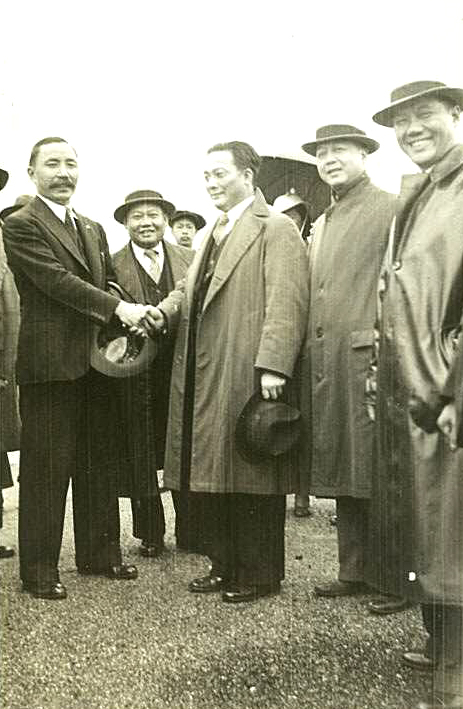
Her father welcomed Dr. Sun Yet Sen the father of modern-day China to Vancouver in 1910 when he was raising money to overthrow the Qing Dynasty. Her family members belonged to the Nationalist Party led by Chiang Kai Shek in China and had to flee to Taiwan when the communists came to power under Mao Tse Tung in 1949. She grew up in the Age of Discrimination in Vancouver and witnessed the degradation her people lived through until the mid-seventies, in a Caucasian ghetto called Chinatown. She lived through the war years and was finally able to become a Canadian citizen after the Chinese fought valiantly in World War II.
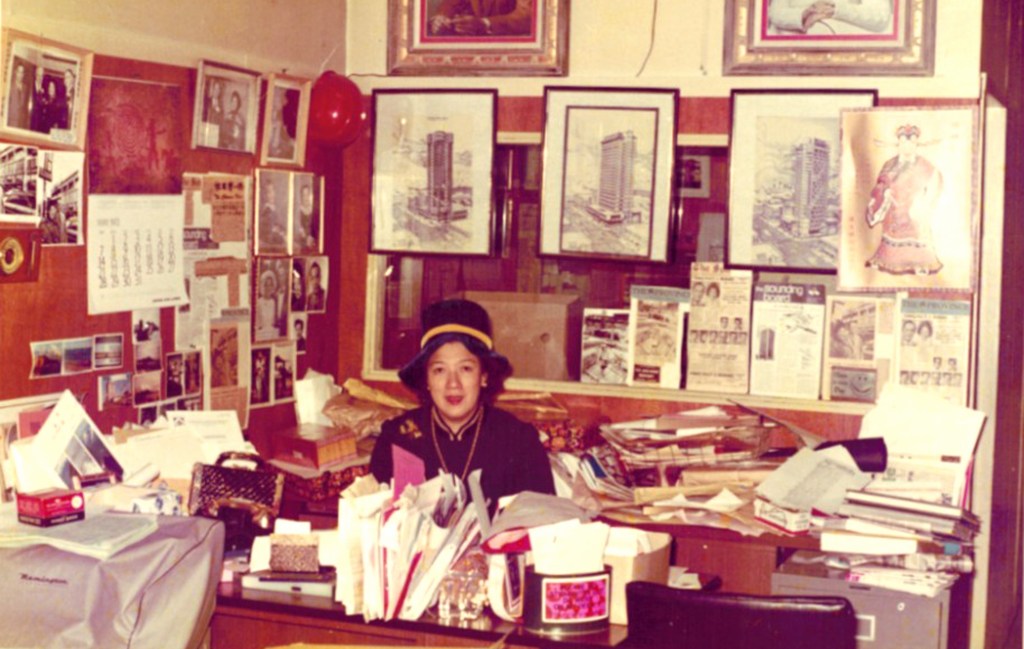
She opened doors into the Caucasian community and her and her husband Dean, showed other young Chinese how to leave the past behind and live a better life in Caucasian society, she was a trailblazer. She started her own real estate company and development company building houses all under $100,000 so young Chinese could get a start in life. She opened the first branch office of any trust company in Canada so Chinese could get a better interest rate on their savings. She travelled to Hong Kong and developed the first overseas banking relationship between a trust company and a big bank so her accounts could make more money and send money home more easily to loved ones in China. When she returned, she changed the immigration laws to allow Asian businessmen with money to come to Canada opening the doors for immigrants from many backgrounds to come as well, thus eventually making Canada the multicultural country we see today.
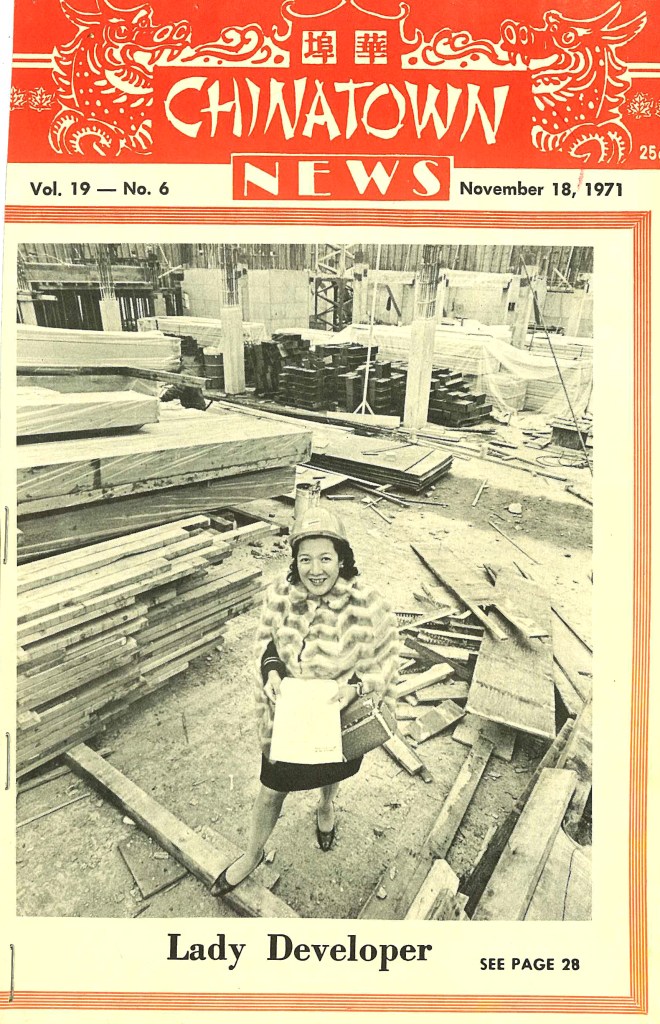
Her development company tabled the Strata Titles Act which allowed buildings higher than three stories. It eventually became the Condominium Act and the buildings went even higher. She did all this in the midst of not only racial discrimination but gender discrimination as women couldn’t sign for a mortgage in the sixties without their husband’s signature. She fought hard with others to change this as well and eventually succeeded and knocked down corporate doors all over downtown Vancouver. Her bank dealings in Hong Kong brought so much money into Vancouver as well as foreign business from changing the immigration laws, she became the darling of the Canadian and Hong Kong business world, everyone wanted to meet and know Faye Leung. She witnessed the building of Simon Fraser University and was asked by the premier WAC Bennett to help raise funds. She and Dean travelled across Canada and the US promoting BC to rubber tire tourism in the sixties.

Because most remember her as the feisty relentless nemesis who brought down the only sitting Canadian Premier in history, I included a chapter that shows a softer side, that of a young girl with all the hopes and dreams of every young girl as she falls in love, gets married to her one true love and becomes a loving mother. Life is not always about success and she had her fair share of ups and downs which just made her more human and compassionate. Dean had an automobile accident in 1974, which left him with a weak heart. Faye takes him to California to find a cure getting involved in a reunion of Some Like It Hot and meets Billy Wilder, Tony Curtis and Jack Lemmon at the Coronado in San Diego. Her story is filled with unexpected moments like this that come out of the blue serendipity if you will.
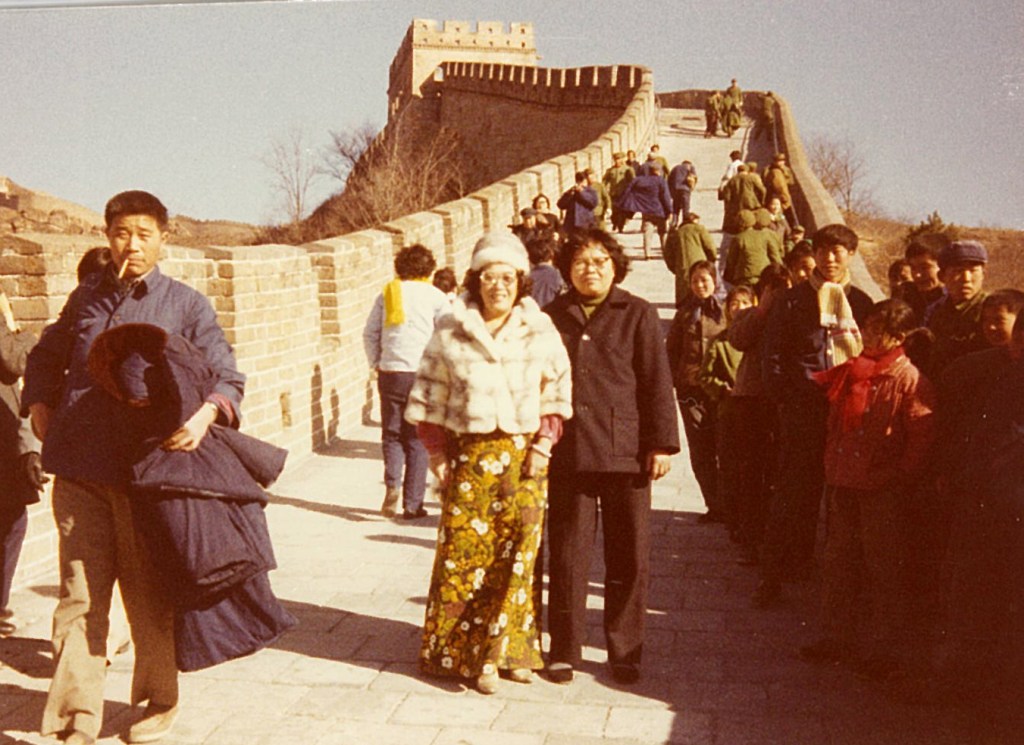
In 1980, her focus changes and the second chapter begins. She is invited by the government of Deng Xiao Ping to come to China to help jumpstart the economy after 10 destructive years under the Cultural Revolution. So she becomes a witness to what life is like in rural China after Mao. Through stories from family and friends, she was also a witness to the horrors of the Cultural Revolution and of the Japanese horror towards the Chinese in WWII. For the next 10 years, she makes many trips to China trying to build stronger ties between her two countries. She travels around the Pacific Rim in a BC delegation in the eighties to promote Expo 86 as well. In 1989, she is in Tiananmen Square just days before the massacre and witnesses the preparations, narrowly escaping on a midnight flight to Shanghai and then Taiwan.
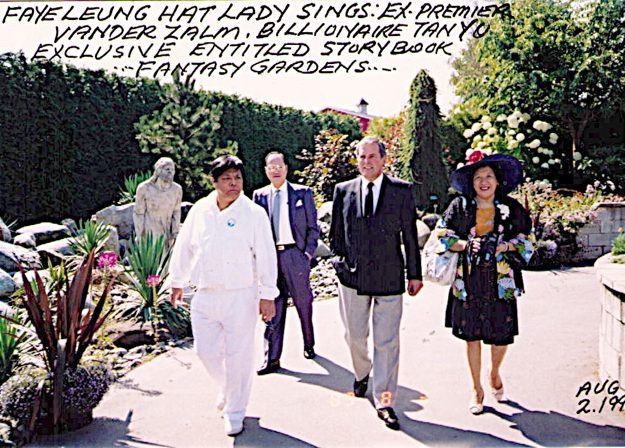
When she returns to Vancouver, there is a message on her answering machine from the premier, he wants her to come out to Fantasy Gardens and meet with him about selling the Gardens. She is immediately thrown into a situation that will change the course of BC politics forever and end in the Premier’s resignation. She again becomes a witness, the crown’s star witness in the trial of the decade, the Crown vs Vander Zalm.
For the last 30 years of her life, she rewrote the chapters of her book over and over and there were many versions. She tried to work with different writers to get her story down but she always wound up scuttling the book before it went to print. She couldn’t send it to print because that would mean to her that the journey had ended and her end so she would find another writer and continue the journey again. She knew eventually it would have to go to print if she was going to leave her life story in print after she was gone but somehow she lost sight of that importance and what became more important was the journey at any cost. Chalk it up to ill health, old age or maybe a sense of immortality she may have started believing this but by the time I came along, I realized she was already quite ill. She would spend an hour or more in the washroom and it was hard to get any work done. I never inquired and she never offered and we left it at that. I figured if she wanted to tell me she would but she never did.

She was happy our first two years together as she was on another journey with a new admirer eager to hear her stories. It was supposed to only be one year as that was all I was paid for but after one year we hadn’t even gotten through half her story so I told her I would work for another year for free. Faye was many things to me, a mentor, a teacher, an educator, a brilliant businesswoman, a source of knowledge about things I knew nothing about, a China political and economic expert and a world traveller and we shared stories of our travels. At some point, I fell in love with the Faye of the sixties, the effervescent, bubbly beauty that everyone fell in love with and wanted to meet, from all walks of life. She gushed and thanked me when I told her.
But in the end when it came time to get ready to go to print, I noticed a change. She wanted things written her way which didn’t follow any norm that made sense. She would have me change things and then tell me I didn’t know what I was doing and tell me to change it back. I remember one time I told her it doesn’t follow the Chicago Style Book of Writing and she said, “There’s no such thing as a Chicago Style Book of Writing, you just don’t want to do it my way.” Having known about the demise of all her other writing partners, I made sure I had what I needed to finish the book. Finally, she just blew up and said she didn’t want a book anymore leaving us all bewildered at the sudden turn of events. We didn’t learn till months afterwards that she had a hidden agenda which isn’t important now. She was caught between a rock and a hard place and the only way out in her mind, was to end the project. The reality of her situation had reared its ugly head. She tried hard to wrestle control of the book away from me but after spending two years on it, and knowing her history I wasn’t about to roll over and play dead so I went off and worked on my own with another editor on the book for another year and got it finished.

In retrospect, even knowing that she needed her book in print so her stories would live on after her, she couldn’t bear to relinquish control, not even to me. Either that or her ill health and old age had left her confused. Maybe she had a last-minute thought that she really was immortal, I don’t know and this too would pass. So the torch was passed on but not until after the first runner had taken a bad fall and the second runner had the foresight to reach down and retrieve the torch from the gutter and save it, and the journey now continues. I can’t help but think that maybe deep down inside lying in her hospital bed she was hoping I would look after her stories and make sure they got out to the world as I told her I would do.
Now you know why the book is important and had to be written but why is it important to continue the journey? Because the book is filled with important stories that are a glimpse into a world and time that no longer exists. It was a quieter more peaceful time even with the wars. It was a time in Vancouver when houses were affordable and the city wasn’t run by developers who have politicians in their pockets. It was a time when jobs were available and the cost of living was bearable, unlike today. It was a time when governments worked for the people and not for themselves. Faye’s stories are Vancouver’s stories and she knew it was important to preserve and pass them on to future generations to give them the vision and inspiration to make change happen and make the world into what could be not settle for what others want it to be.

So the journey continues to get her stories out to the world through a movie based on her book, called, THE WITNESS about the metamorphosis of Vancouver from a sleepy fishing village on the west coast of Canada into a jet-set capital of the world and the rise of modern-day China as seen through the eyes of the first Chinese Canadian businesswoman to be invited to China to help jumpstart their economy by Deng Xiao Ping’s government after the fall of the Cultural Revolution.
Chris Best, from his book: It Ain’t Over Until Faye Leung the Hat Lady Sings.
See book in our online library at www.issuu.com/metroguides
 The Best Little Movie House in Vancouver